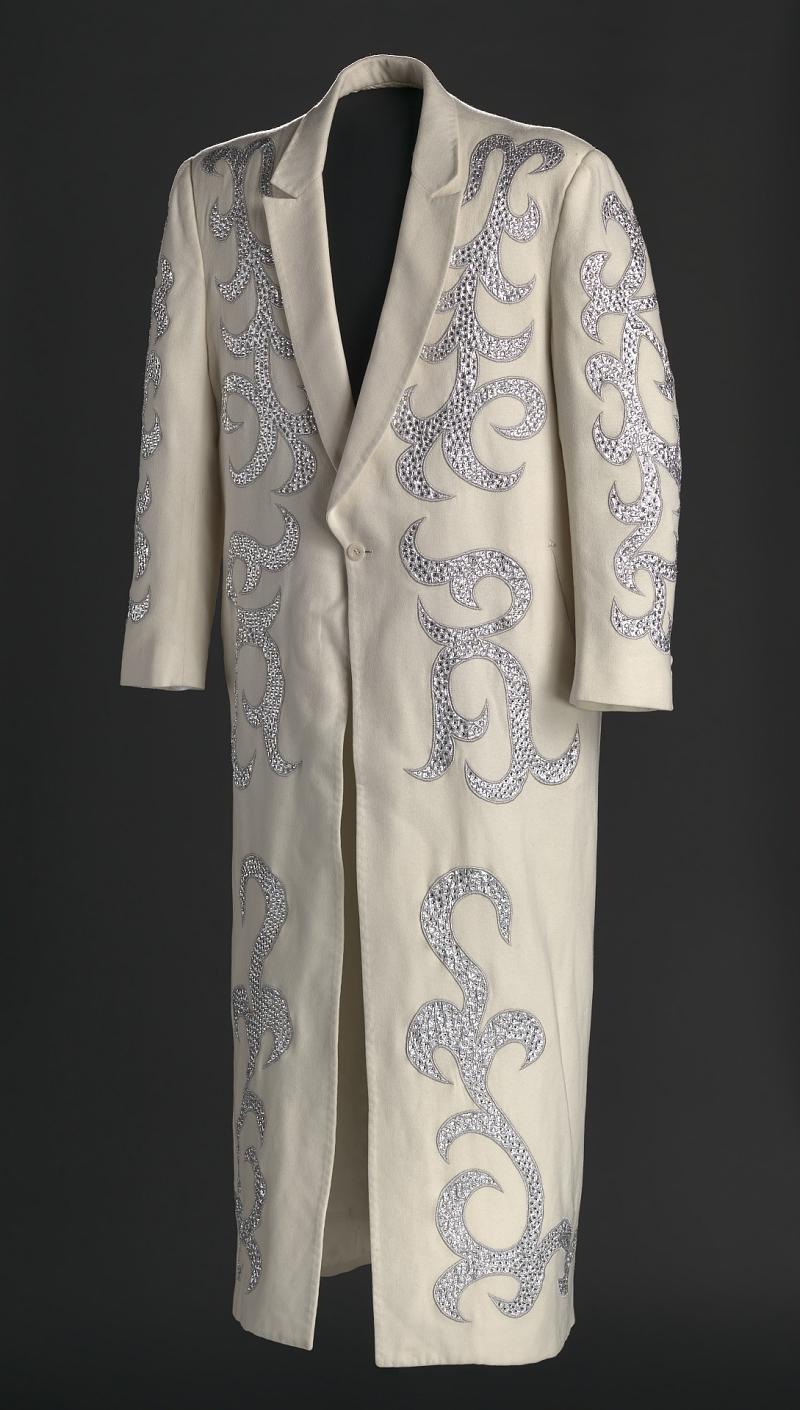
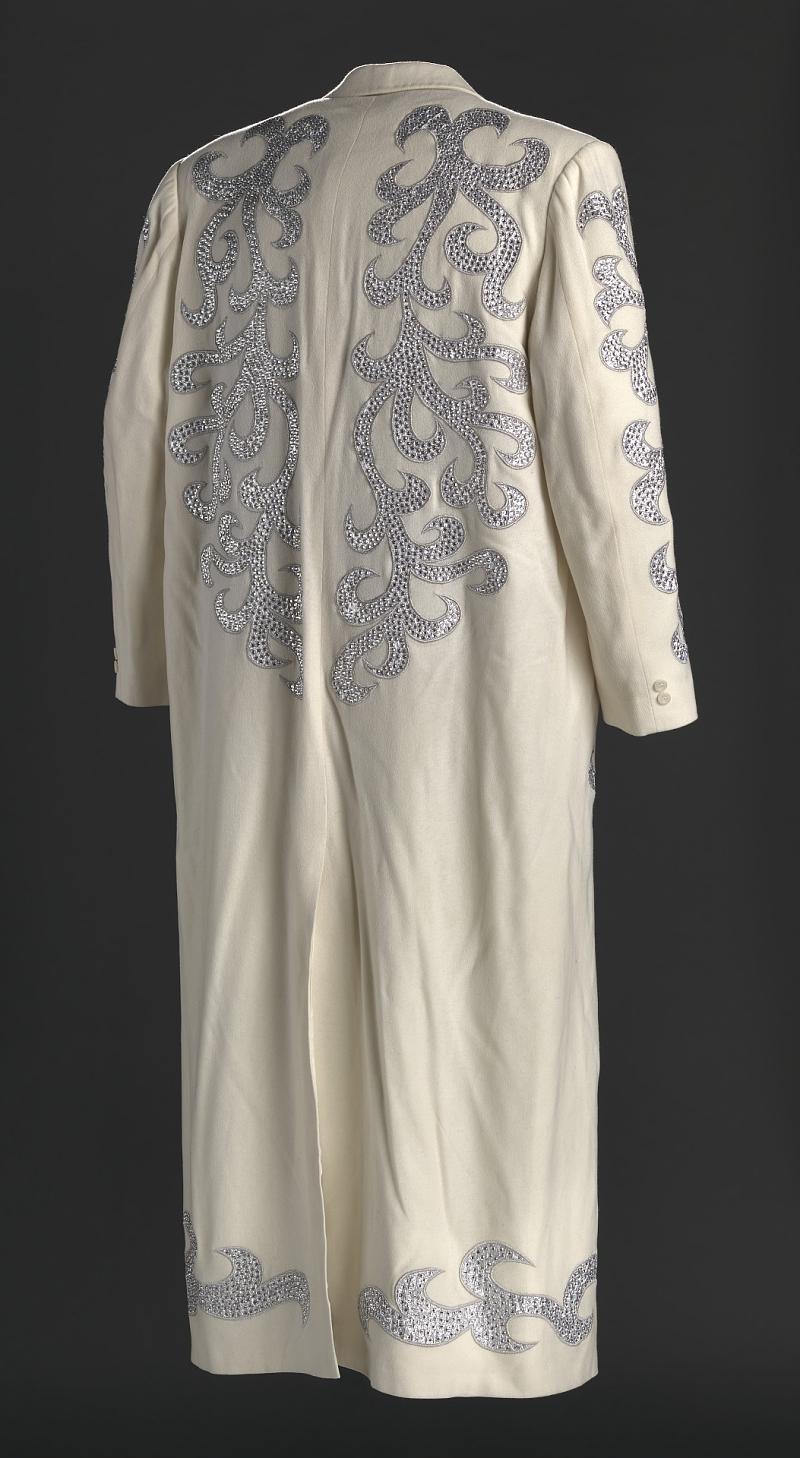
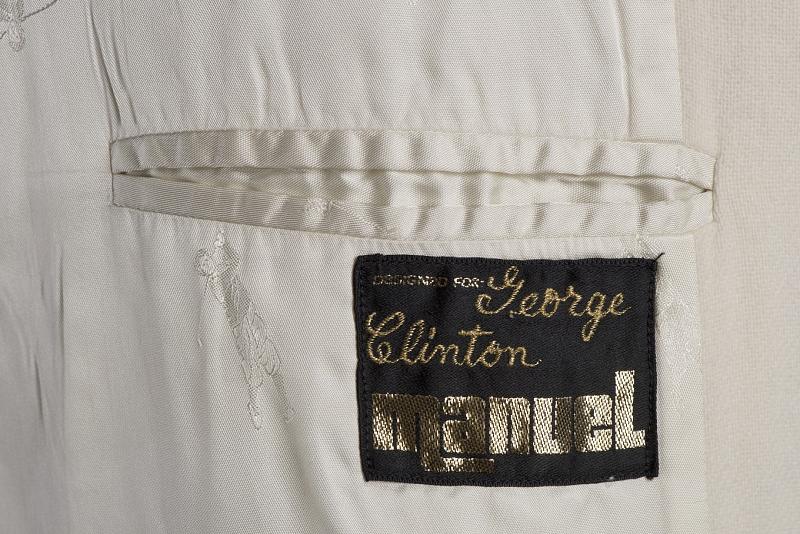
A cream wool duster in the Smithsonian’s National Museum of African American History and Culture carries an interior label: “DESIGNED FOR George Clinton manuel.” The museum identifies the garment as made for Clinton in 2009 and worn at that year’s BMI Awards in New York. Arrowhead pockets, silver-lamé scroll appliqué, rhinestones and metallic thread turn a Western vocabulary toward one of funk’s most individual performers. The coat is a good place to begin because it joins the maker’s name, a named wearer and an occasion in one object record.1
Learning by making
In a published conversation with Friends of Friends, Cuevas remembered his older brother teaching him to sew when he was seven. He began with shirts and trousers for himself. Later, at about thirteen, he made prom dresses for girls in his town; he recalled making 77 in one year and 110 the next. The numbers come from memory rather than order books, but the sequence is telling: the designer known for dressing stars began by making clothes for himself and his neighbours.2
Cuevas’s account of arriving in Los Angeles is about fit before spectacle. He said he applied for pants-making work and was sent to Sy Devore, whose clients included Frank Sinatra, Sammy Davis Jr., Dean Martin and Bob Hope. At first, Cuevas recalled, his work involved fittings. Customers asked for corrections; he learned to notice the line of a trouser and how it sat on a body. That practical schooling would matter in a career where the clothes were vivid, but still had to be worn.2
The Rose Parade and the embroidery machine
Several accounts place a turning point at the Rose Parade. In interviews, Cuevas remembered seeing embroidered parade clothes and wanting to learn how they were made. AARP recounts that he asked about the work and was introduced to Viola Grae; Cuevas said he went to work with her and learned embroidery. The Tennessee resolution also says he worked in Grae’s studio and learned to use an embroidery machine there. The passage from parade spectacle to workshop skill carries Grae into the story as a teacher as well as a named embroiderer.3, 4, 5, 6
The Hall of Fame describes Cuevas as a freelance designer for Nathan Turk before he went to work for Nudie Cohn. PBS tells the transition differently, saying Turk was not hiring when Cuevas approached him and that Cuevas then got a job with Nudie. The accounts put Cuevas in the same Southern California network, but they do not give one settled version of his professional relationship with Turk.6, 7, 8
With Nudie, Cuevas became part of a workshop whose public name was more famous than most of the people who made its clothes. In the Friends of Friends interview, he described himself as head tailor, head designer and partner, and said he worked there for fourteen years. The Hall of Fame’s story of the Nudie shop likewise names him as a leading designer. His own account adds the sound of a working life: after the fittings and the embroidery, he was making clothes for performers whose public identities grew alongside their careers.2, 9, 6
Designing with the wearer
The Flying Burrito Brothers’ late-1968 costumes show how the process could begin with the performers. A Hall of Fame exhibition publication says the group went to Nudie’s and worked with Cuevas to choose colours, fabric and embroidery. The four suits became famous together through the album cover, yet each carried a different set of images. In this account, the clothes were not simply assigned from a shop’s stock of designs: the musicians took part in making the visual choices.10
One of the four suits later travelled from Chris Ethridge to Elton John and back toward the band’s history. A 2023 account published by the Hall of Fame says the Ethridge suit returned to Nudie’s shop in 1969 after being reported stolen, was bought by Elton John in 1970, and appeared on television in 1971 and on the British “Rocket Man” single sleeve in 1972. Ethridge’s daughter Necia later acquired it at auction and lent it to the museum. The sequence belongs to the museum’s account of the suit’s history; its reunion with the other three garments in 2023 gave the group’s wardrobe a new life as a collection.11
A method in paper and cloth
In the same interview, Cuevas described how he made a later design at his Nashville shop. He drew the jacket’s sections on paper, perforated the pattern so marks transferred to the cloth, then embroidered, applied rhinestones and assembled the garment. The account offers a rare glimpse of a design becoming a wearable object one stage at a time. It describes his later practice; it should not be mistaken for a documented work sequence at Nudie’s.2
His independent shop opened in North Hollywood in 1975, according to the Hall of Fame. The museum presents a label reading “Manuel / Exclusively Clothier” and a range of garments for performers. In 2009, the George Clinton duster shows the language of Western clothing continuing into a different musical world. Its long line, scrolls and arrowhead pockets do not erase where the garment came from; they show a tailor reshaping a vocabulary for a particular wearer.6, 1
Cuevas’s story crosses the shop floors of Sy Devore, Viola Grae and Nudie Cohn, then reaches an independent business with its own name. The roles mattered: fitting, embroidery, design, customer choices and construction were different kinds of work. A famous suit may carry one label, but the history of how it was made is richer when we can follow the people and decisions behind it.2, 3, 6, 10
Sources
- Smithsonian National Museum of African American History and Culture, Cream duster coat designed by Manuel Cuevas and worn by George Clinton, object 2011.83.4
- Sarah Rowland, Friends of Friends, Manuel Cuevas interview
- AARP, Manuel Cuevas interview
- Anja Aronowsky Cronberg, “The Colour of Oil and Money,” Vestoj
- Tennessee Joint Resolution 998
- CMHOF, “Manuel: The Rhinestone Rembrandt”
- PBS, Manuel Cuevas biography
- National Endowment for the Arts, Manuel Cuevas
- CMHOF, “Nudie Cohn: The Original Rhinestone Cowboy”
- Country Music Hall of Fame and Museum, Western Edge: The Roots and Reverberations of Los Angeles Country-Rock
- Country Music Hall of Fame, Flying Burrito Brothers suits reunion, 20 July 2023