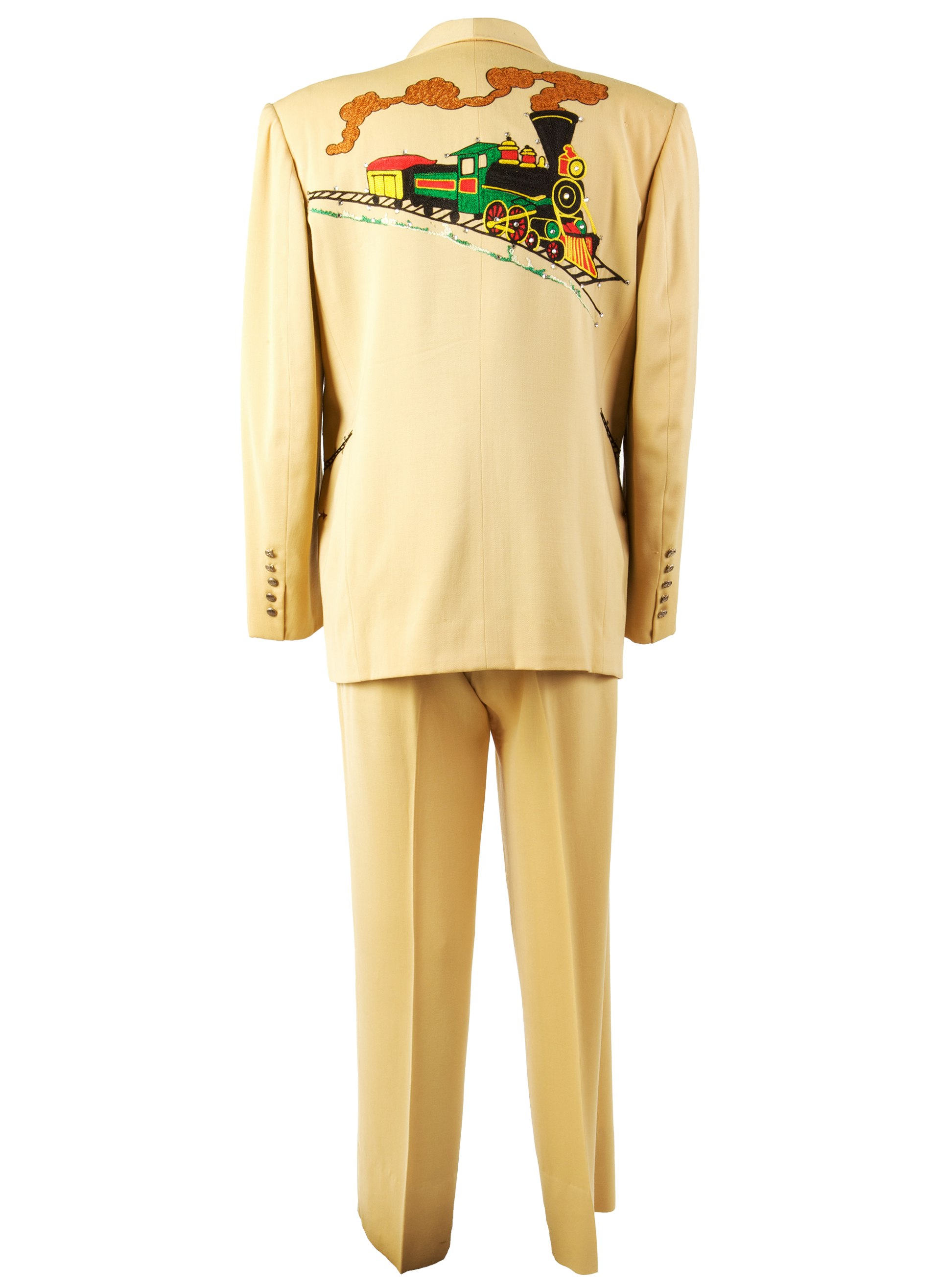
Hank Snow wanted steam trains on a suit: old locomotives, dark smoke, a coat in a colour somewhere between amber and cream. The Country Music Hall of Fame preserves Snow’s request in its account of the garment. It is a small exchange, but it opens the door to Nudie Cohn’s world. A performer brought an idea tied to his songs and public image; a shop had to translate it into cut cloth, stitched pictures and something that could be worn under the lights.1
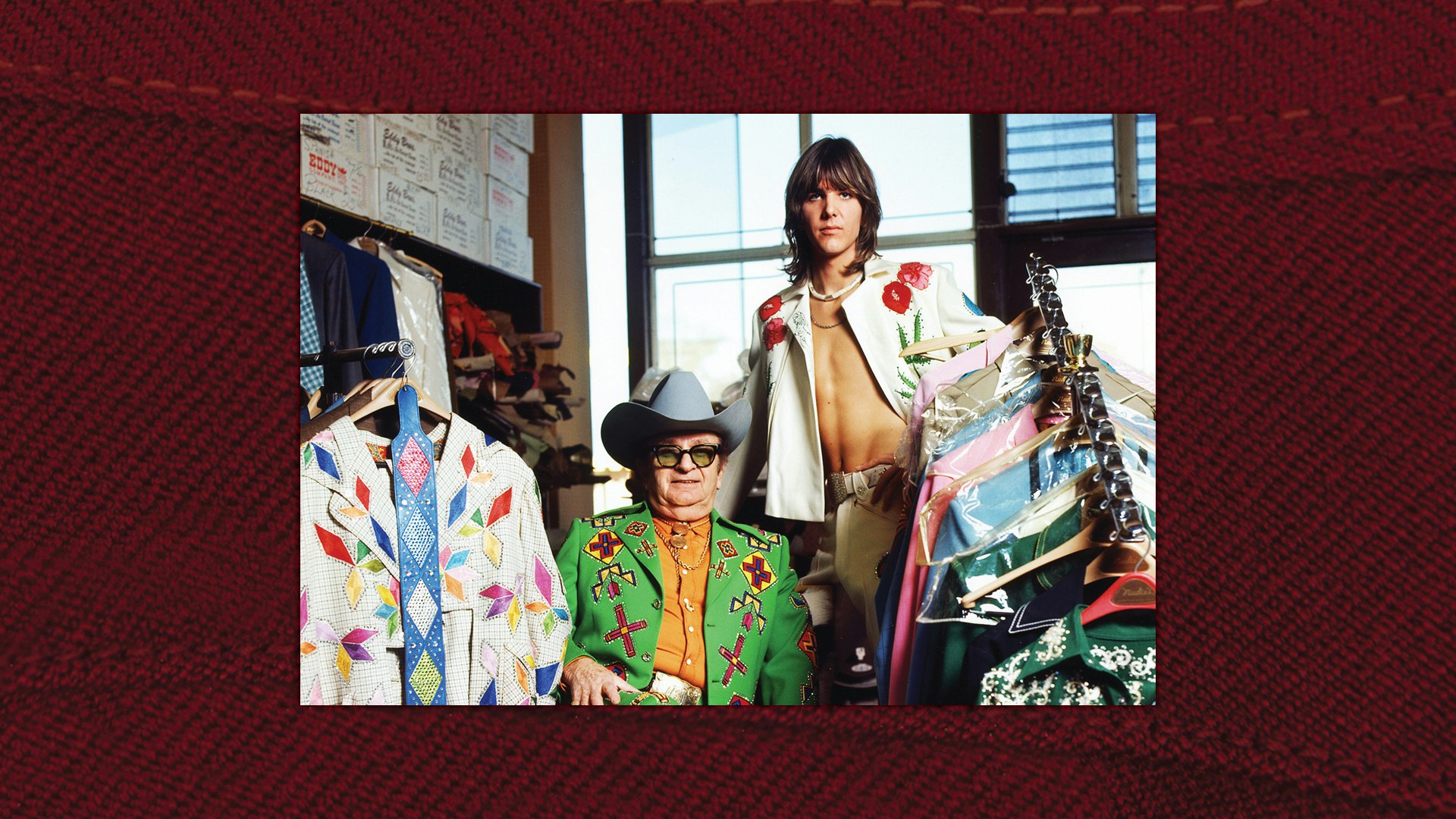
Nudie’s name became so closely associated with spectacular Western clothes that people now apply it to garments his shop never made. The real business was more than a signature style. It was a working shop, a family enterprise and a gathering place for performers, tailors, embroiderers, bootmakers, leather workers and customers. Its story comes into focus through the people at work and the individual objects they made, repaired, sold and wore.1, 2
Before North Hollywood
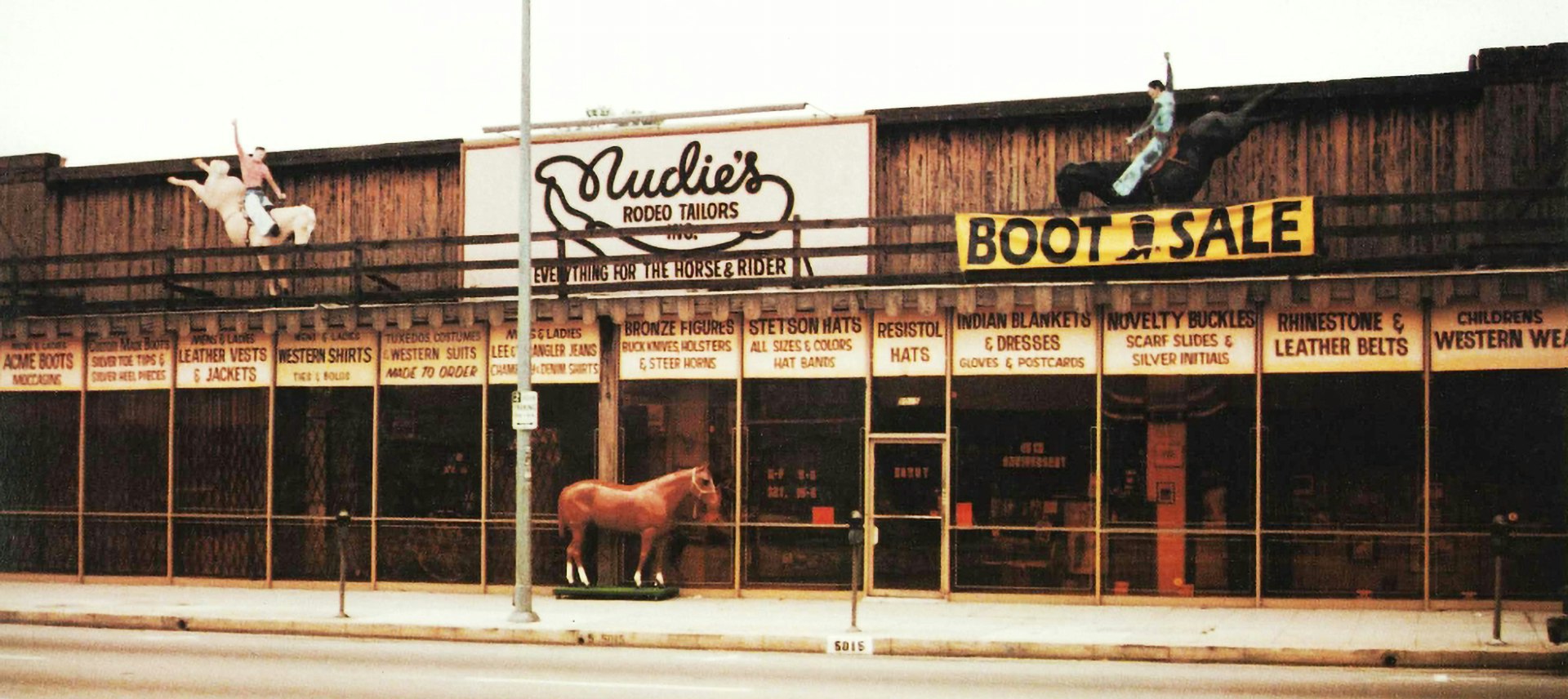
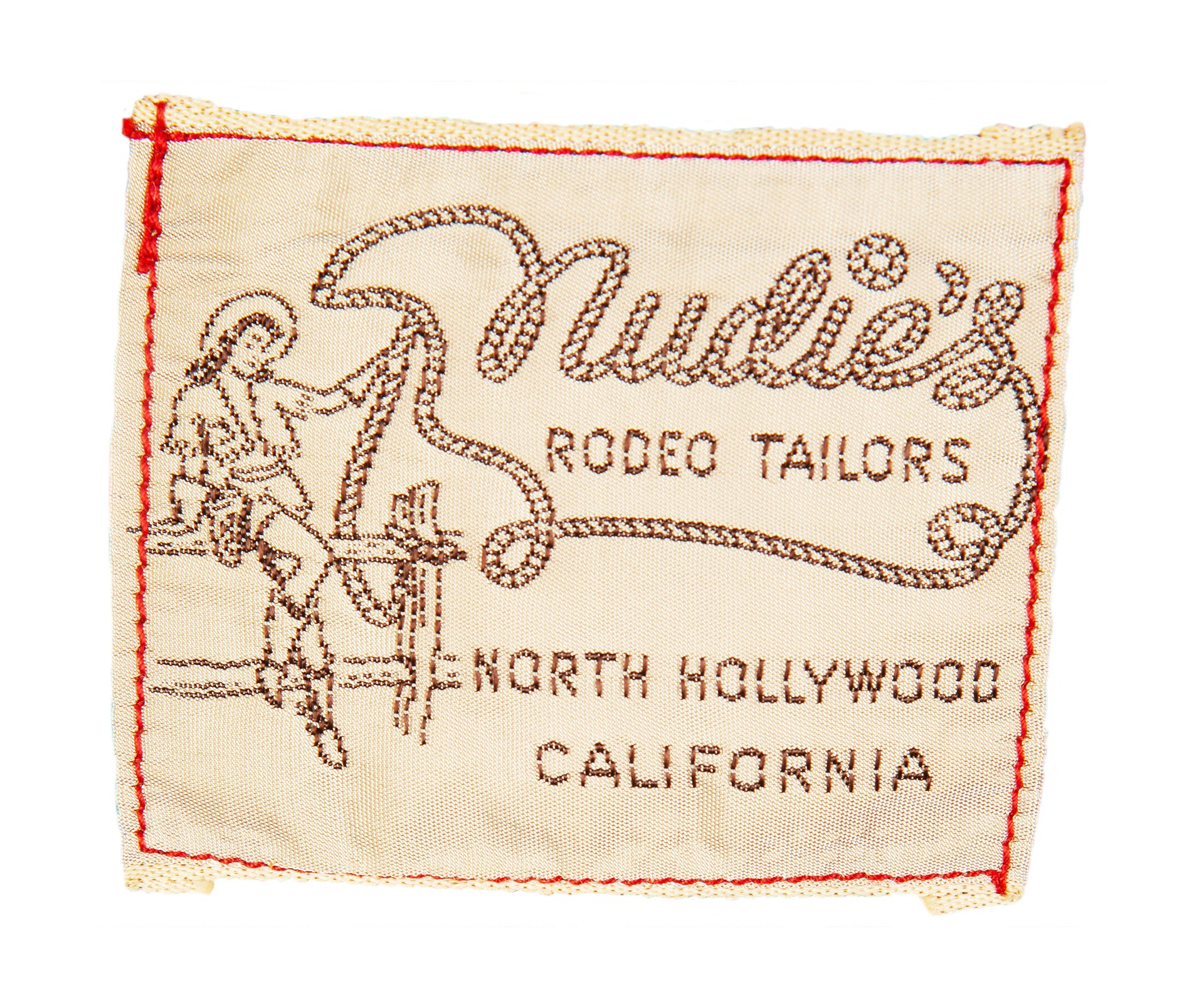
Nudie and Bobbie Cohn began their clothing business in Manhattan. The Hall of Fame dates the opening of Nudie’s for the Ladies to 1934 and describes its early work as burlesque costumes. After the couple moved to Los Angeles, Western swing performers became important customers. Nudie’s Rodeo Tailors opened in North Hollywood in 1950. The change in location and clientele did not leave the stage behind: in each setting, a garment helped a performer make an entrance.1
The shop’s address changed as the business grew. The Autry’s finding aid says it moved from Victory Boulevard to a larger Lankershim Boulevard location in 1963. It also records fourteen employees in 1954. These details bring scale to the image of a single tailor at work: Nudie’s was already a staffed operation, with room for different kinds of making and a larger shop to come.2
Bobbie Cohn’s work was part of the business’s public success. Family-based reporting describes her taking orders, keeping the books, greeting customers and helping decide how much embroidery or rhinestone work a garment needed. The Autry’s records also preserve billing, correspondence and customer files—the paperwork of a shop that had to remember who wanted what, how it would be paid for and when it had to be ready. Nudie’s was a name above the door; Bobbie helped keep the promises made beneath it.3, 2, 4
The stock reached beyond men’s stage suits. A “Ladies’ Price List” presented by the Hall of Fame is headed “Nudie’s Rodeo Tailors and Western Equipment” and gives a Victory Boulevard address. It lists gabardine and leather skirts, divided skirts, boleros and a four-piece leather “Cover Girl Suit.” The page shows a business addressing women customers and offering separates as well as performance clothes.1
Two accessioned Autry garments turn that commercial language into clothes. A circa-1950s shirt made by Nudie’s for Gene Autry’s personal appearances is off-white wool gabardine with a red bib, piping and snaps; its embroidered bib carries an American flag and the pre-1965 Canadian Red Ensign. A second, women’s outfit separates the contributions inside a coordinated Western look: the Autry credits its shirt and trousers to Nudie’s, its hat to Eddy Bros., boots to Tony Lama, belt to Chambers Belt Co. and scarf to Dorian, Ltd. The garments show the shop making stage-ready shirts and trousers while a complete outfit could bring together several specialist makers.5, 6
A suit made to answer a song
The Hall of Fame tells a story about Lefty Frizzell’s 1951 suit: Nudie added rhinestones, the audience responded, and Frizzell came back wanting more. In that account, ornament is not excess for its own sake. It helped the singer hold attention. A small stone caught the light; a complete outfit carried the same visual message across the stage.1
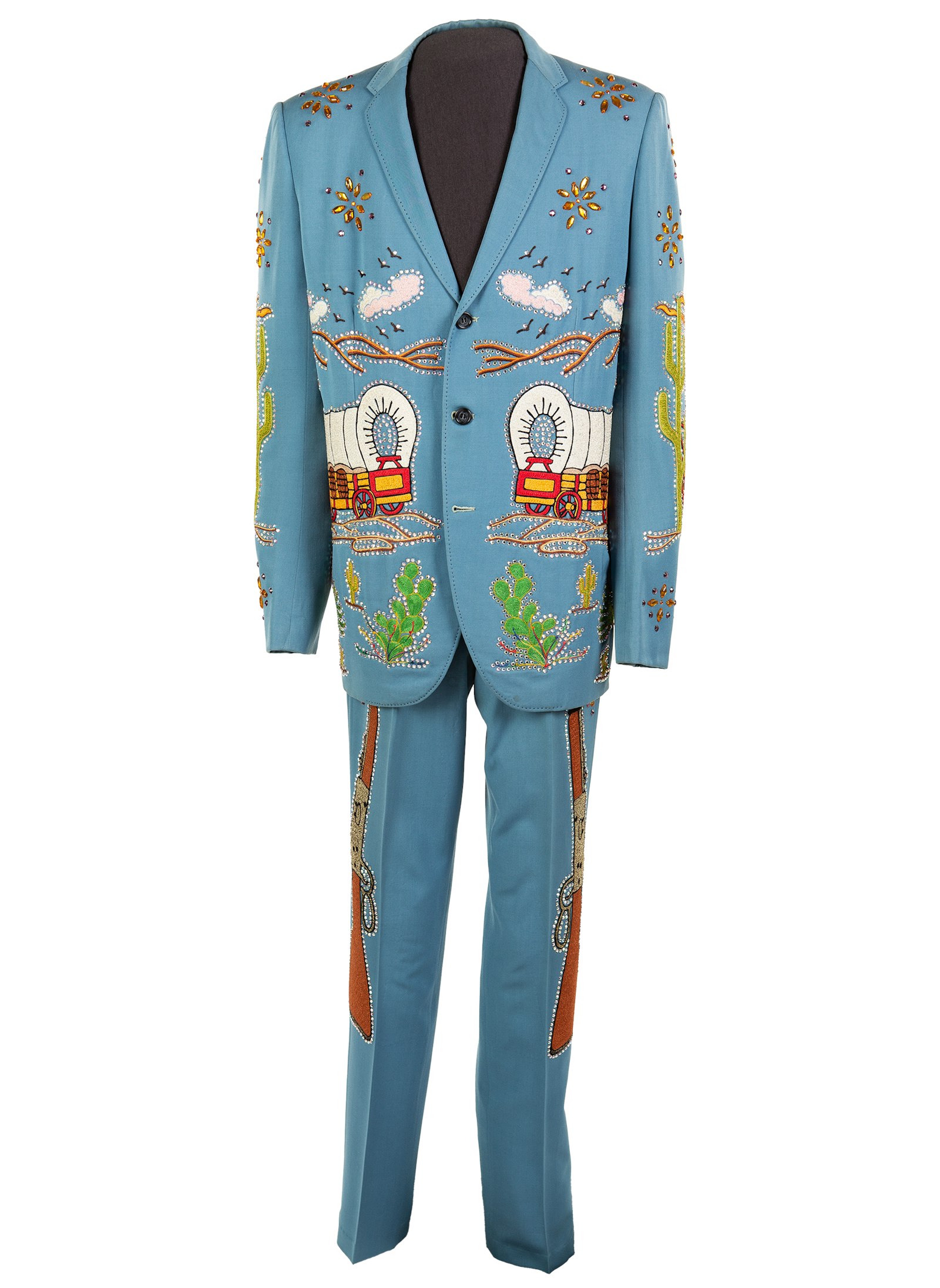
Other garments turned a performer’s name or repertoire into pictures. Snow’s locomotives echoed “I’m Moving On.” Webb Pierce’s jailhouse imagery drew on one of his songs. Porter Wagoner wore covered wagons that played on his name. The blue suit the Hall of Fame presents for Wagoner is crowded with covered wagons, cactus, rifles and desert scenes, worked with beads and rhinestones. Seen from a distance it reads as colour and sparkle; up close, the surface becomes a story.1, 7
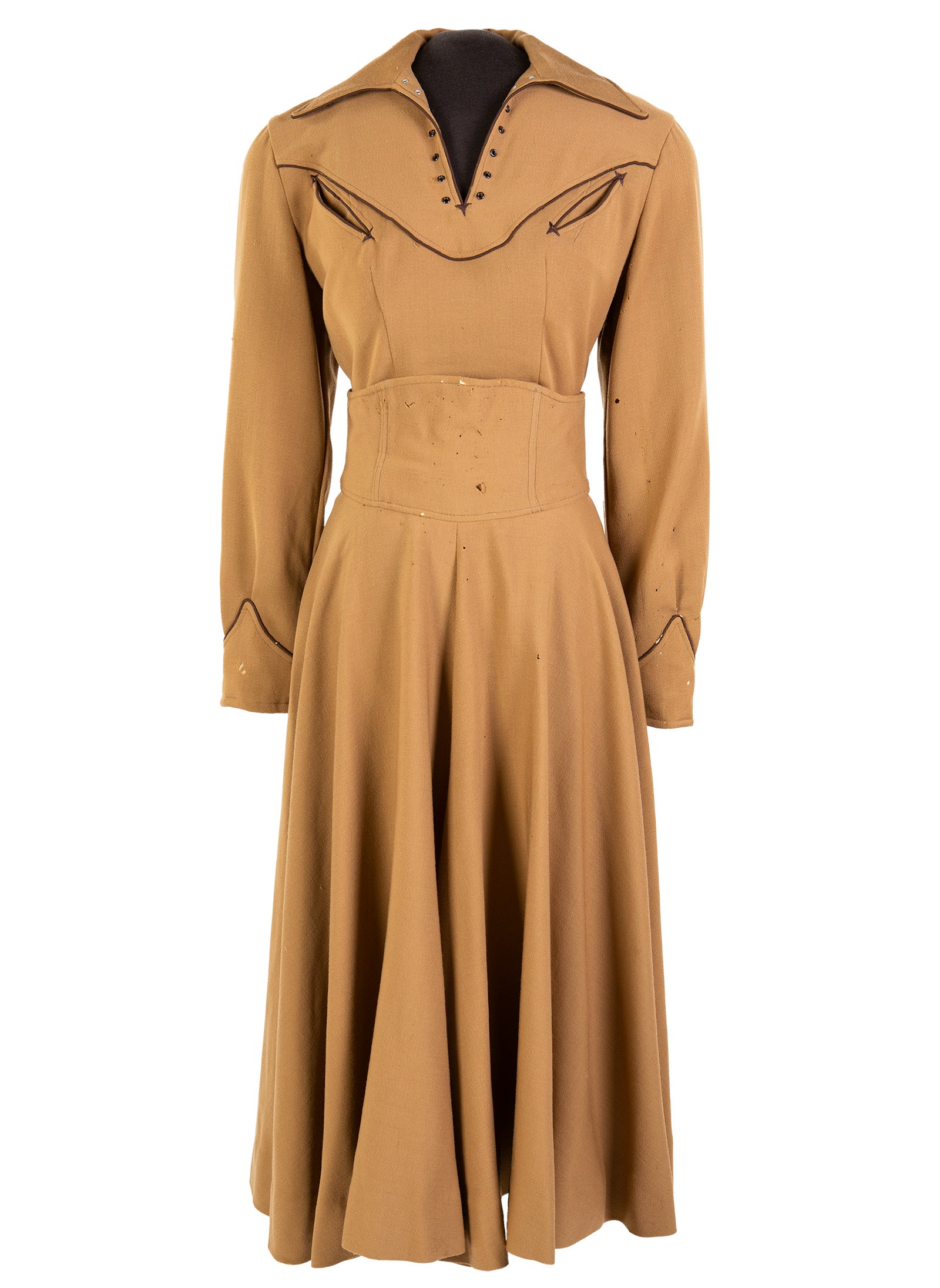
Not every customer needed a pictorial landscape. Cindy Walker’s early-1950s wool-gabardine shirt and split skirt use shaped lines, piping and pointed pockets. The Hall of Fame’s description and photographs let the cut carry much of the interest. A shop associated with flamboyant stagewear also made a quieter silhouette for a woman performer.7
An accessioned Smithsonian suit for country-music executive Connie B. Gay gives a different view of the wardrobe. Made in 1956, the two-piece Western business suit has stitched pocket details and arrows on the sleeves and front. The museum says Gay wore it for appearances on CBS and ABC and, according to friends, at home. The garment’s life moved between the broadcast set and ordinary private wear.8
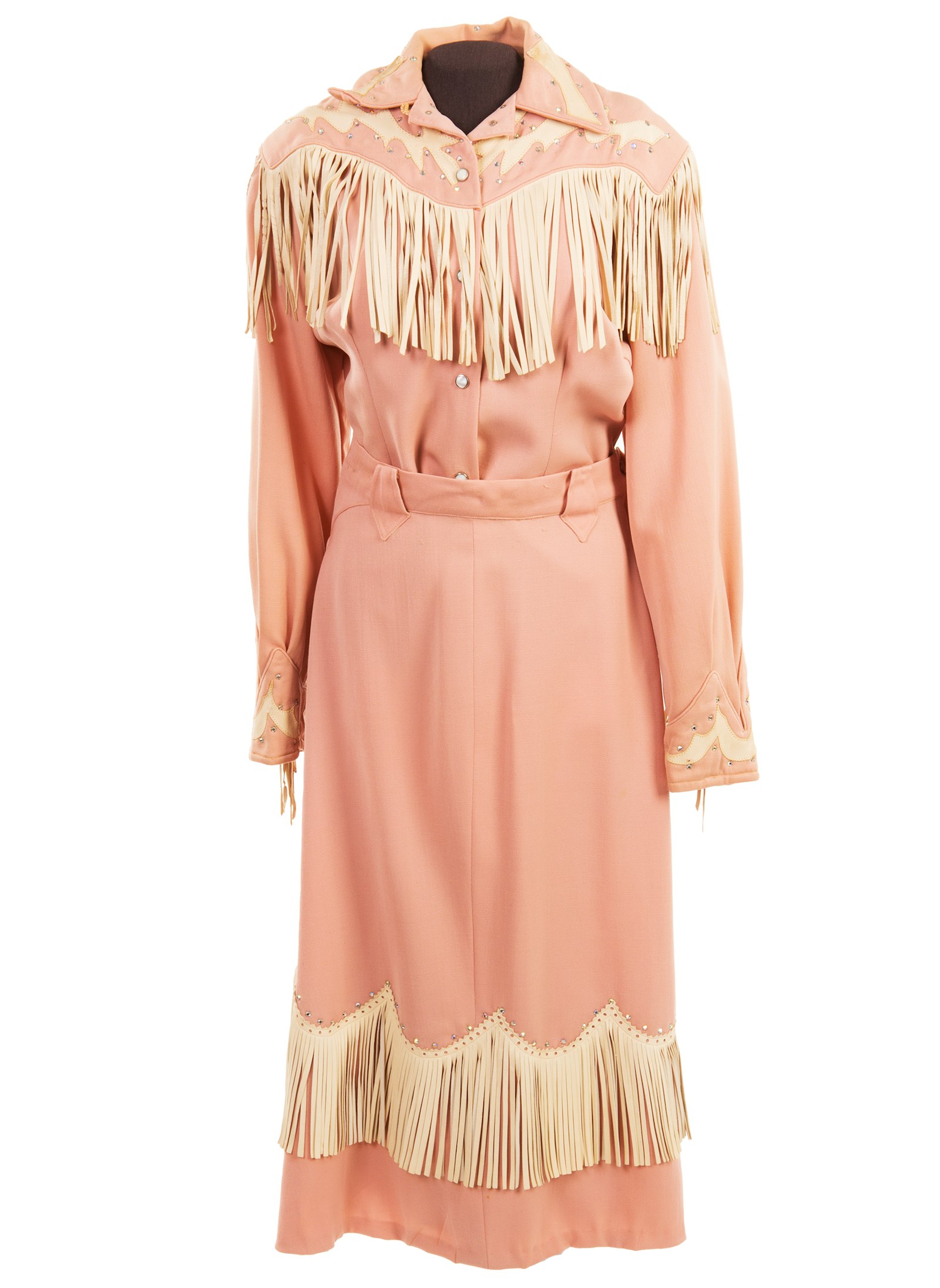
Emmylou Harris’s pink outfit travelled from another performer’s wardrobe. The Hall of Fame says it was designed for actress Gale Davis and that Harris bought it while touring with Gram Parsons in the early 1970s. Its later use gave a garment a second musical life, without erasing the person for whom it was first made.7
The people behind the label
The Autry’s finding aid calls Viola Grae and Rose Clements master embroiderers in Nudie’s workshop. The Hall of Fame credits Grae with the scene on Hank Thompson’s “Humpty Dumpty Heart” boots and places Clements in the shop’s embroidery story after her arrival in Los Angeles in 1963. Manuel Cuevas became a leading designer; Jaime Castaneda worked as a tailor. Bobbie’s orders and books connected the workroom to customers. These names bring the shop’s distinct kinds of labour into view.2, 1, 3
The Flying Burrito Brothers’ late-1968 suits make performer choice part of that team story. A Hall of Fame publication says the band chose colours, fabric and embroidery in consultation with Cuevas. David Browne’s 2023 account on Chris Hillman’s official website also names Cuevas, embroiderer Rose Clements and tailor Castaneda among the Cohn shop team. The four suits later became one of the most reproduced images of country-rock, but their making involved distinct roles and a conversation with the musicians.9, 10
One of the four, Chris Ethridge’s white rose-covered suit, made an extraordinary journey. The Hall of Fame’s 2023 account says it was reported stolen in 1969, returned to Nudie’s shop that year and was bought by Elton John in 1970. John wore it on Top of the Pops in 1971, and it appeared on a British “Rocket Man” sleeve in 1972. Ethridge’s daughter Necia later acquired the suit at auction and lent it to the museum. Its reunion with the other three band suits placed four individual visual ideas back together: roses, dinosaurs, sea imagery, and Gram Parsons’s mixture of flowers, women and a cross.11
Browne’s account follows the suit through occasions beyond the stage. John wore it as best man at Bernie Taupin’s wedding in 1971. In 1988, it entered John’s Sotheby’s sale, where a Scottish collector bought it for £4,000. Kerry Taylor, who had worked on that sale, later handled its resale through her own auction business. Her catalogue noted Ethridge’s name inside the jacket and trousers: a small label helped reconnect a celebrated pop wardrobe with the country-rock musician who had first worn it.10
A business visible in the trade press
The working shop also surfaced in trade columns and advertisements. In February 1953, Cash Box reported that Bob Wills and his band had recently received a new Nudie wardrobe in blue and white, with a contrasting black-and-white suit for Wills. A year later, Billboard announced a testimonial luncheon organised by Roy Rogers, Tex Williams and Rex Allen; Cash Box then reported that it had taken place. In 1955, a complete Western outfit by Nudie was offered as a contest prize. These brief notices show the tailor moving through an industry of bands, radio, publicity and fan events.12, 13, 14, 15
The notices continue into later decades. Record World reported Nudie taking clothing orders at a hotel gathering in 1966. Cash Box described him attending Judy Lynn’s Las Vegas debut in 1970 to approve a costume made for her. In 1976, a caption associated him with ZZ Top’s stage outfits. The customers and venues changed; the shop remained a point where performers could bring an idea for what they wanted to look like.16, 17, 18
Johnny Cash’s 1976 Bicentennial suit carries that public-image work into a specific national occasion. The Old State House Museum dates the black wool-gabardine suit to 1976 and attributes it to Nudie. Eagles, blue stars and the dates “1776–1976” appear in its decoration; the museum associates it with Cash’s appearance before Congress. Here the garment links one performer’s image to a public anniversary.19
What the archive lets us see
Nudie’s Rodeo Tailors Archives, donated to the Autry by Helen B. Cohn in 1994, include customer files, swatches, drawings, correspondence, photographs and publications. A fifty-five-folder group of billing ledgers and related customer, contact and payment documents preserves the business side of the famous photographs: requests, cloth choices, sketches, accounts and finished objects.2, 4
The wardrobe also travelled well beyond California. Bobbejaan Schoepen and Josée’s collection of clothes and ephemera became the subject of Antwerp’s Dream Suits exhibition in 2011–12. Researcher Mairi MacKenzie describes the work of cleaning, inspecting, cataloguing, photographing and improving storage for the garments. MoMu’s record for suit B12/8A identifies a Nudie suit worn by Bobbejaan in the 1970s. In a museum store, lining and interior construction remain part of the evidence, not hidden details.20, 21, 22
The collection also entered a contemporary fashion conversation. MacKenzie’s portfolio reproduces a Knack Weekend feature that announced the 2011 MoMu exhibition and styled Belgian performers in pieces identified in its captions as Nudie or Manuel. Those images do not tell us who first commissioned a garment or who made every part of it. They do show another life for the clothes: a collection could leave the private wardrobe, enter conservation, then become a way for another generation of performers to think through Western dress.21
Nudie’s history is not only the story of a celebrated tailor or a glittering suit. It is a history of customers who arrived with songs and ideas, of family and skilled workers who turned those ideas into garments, and of clothes that carried their meanings from shop to stage, screen, home and museum. Look at the train on Snow’s suit or the stitching inside a jacket; both belong to the same history of making.1, 2, 22
Sources
- CMHOF, “Nudie Cohn: The Original Rhinestone Cowboy”
- Online Archive of California, Nudie’s Rodeo Tailors Archives, 1950–1994
- Los Angeles Times, Bobbie Nudie obituary (2006)
- Autry Collections, Nudie financial records 95.6.1
- Autry Collections, Gene Autry shirt by Nudie’s Rodeo Tailors, 91.221.505
- Autry Collections, women’s Western outfit with Nudie’s shirt and trousers, 93.189.1
- CMHOF, “Nudie Suits and Boots”
- National Museum of American History, Connie B. Gay suit, CS.311817.001
- Country Music Hall of Fame and Museum, Western Edge: The Roots and Reverberations of Los Angeles Country-Rock
- David Browne, The Bonkers Tale of the Stolen Flying Burrito Brothers, Chris Hillman official site, 24 July 2023
- Country Music Hall of Fame, Flying Burrito Brothers suits reunion, 20 July 2023
- Cash Box, 21 February 1953
- Billboard, 12 June 1954
- Cash Box, 3 July 1954
- Cash Box, 1 October 1955
- Record World, 17 December 1966
- Cash Box, 20 June 1970
- Record World, 28 August 1976
- Old State House Museum, Johnny Cash suit, 1976, object 1986.047.06
- Glasgow School of Art, Dream Suits exhibition record, MoMu, 2011–12
- Mairi MacKenzie, Dream Suits research portfolio, Glasgow School of Art, PDF pp. 7–8, 13, 17, 21–29
- MoMu, The Philosophy Behind MoMu’s Acquisition Policy; suit caption, inventory B12/8A