The Country Music Hall of Fame credits Viola Grae with the embroidered scene on Hank Thompson’s “Humpty Dumpty Heart” boots. It is a small surface carrying a whole picture, shaped to a boot rather than a flat page. The museum says Grae worked at Nudie’s on a chain-stitch machine; the Autry’s finding aid calls her a master embroiderer in the shop. Between those records, she emerges as a maker whose work belonged to the visual life of Western performance.1, 2
A picture shaped for cloth
Chain stitch turns a line of thread into a drawn line. On a boot, the image has to follow a curved surface and the construction of the leather as well as the performer’s idea. The Hall of Fame’s account of Thompson’s boots ties Grae’s name to one specific scene and object. That credit matters because it gives a name to work that a shop label alone would leave anonymous.1
The Autry’s finding aid places Grae within a workshop that also included Rose Clements, whom it names as a master embroiderer. The Hall of Fame describes Clements arriving in Los Angeles in 1963 and taking over the shop’s embroidery work. Seen together, the records place Grae in an earlier chapter of the shop’s embroidery history; they do not provide a complete employment chronology or assign every surviving embroidered garment to one of the two women.2, 1
Three ways a name appears
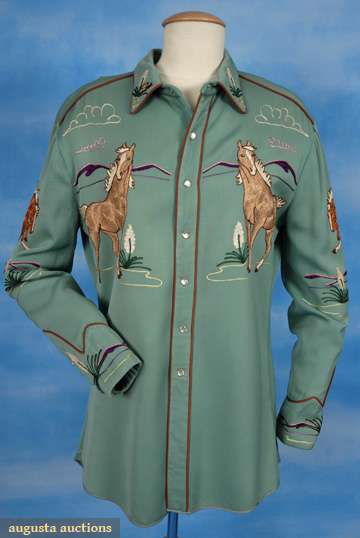
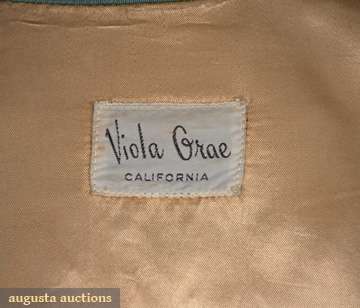
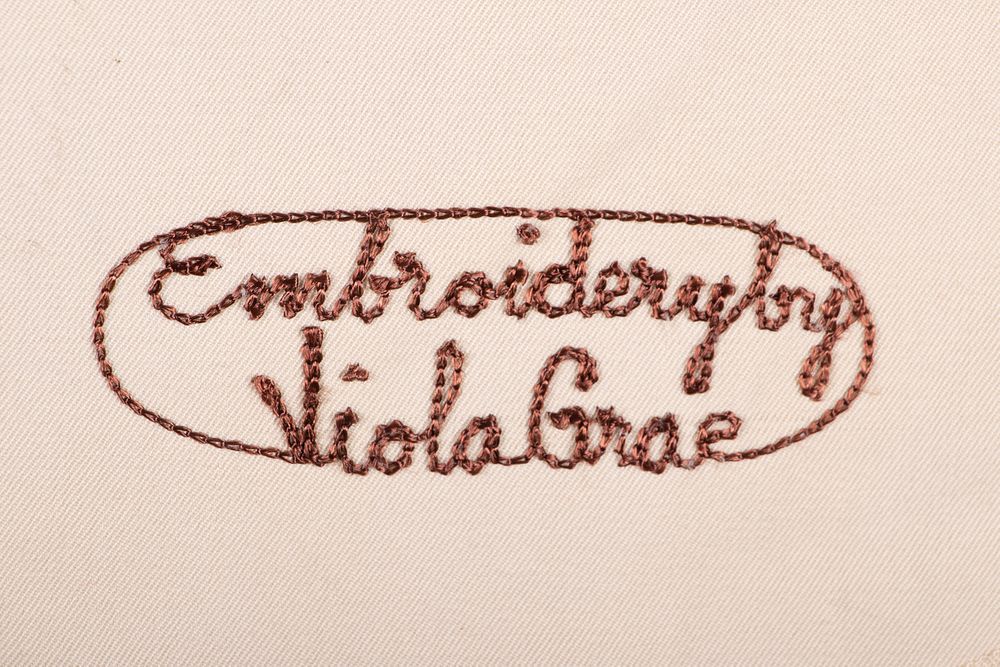
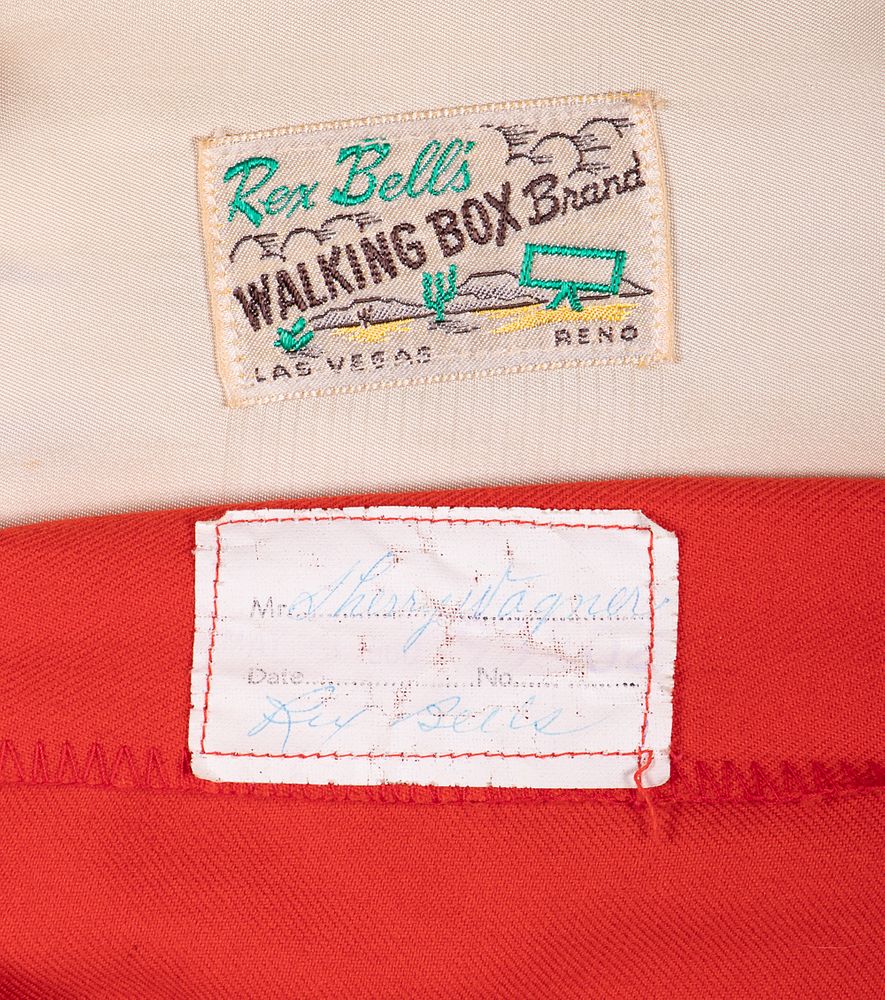
Photographs from separate garment listings show the label “Viola Grae / California” on a shirt presented by Augusta Auctions and on a jacket presented by the dealer Of the Palms. A different auction-presented shirt carries the words “Embroidered by Viola Grae” beside a separate label for Rex Bell’s Walking Box Brand. The wording offers three distinct clues: her name inside a garment, her name on another maker’s workwear, and an explicit embroidery attribution on a branded shirt.3, 4, 5
The wording is worth attending to. “Viola Grae / California” presents her name on the shirt and jacket labels; “Embroidered by Viola Grae” describes a contribution within a shirt that also carries another brand. The phrases show more than one way a craft worker could be credited.3, 4, 5
Teaching and learning
Manuel Cuevas’s later accounts bring Grae into view as a teacher. In a 2016 interview, he remembered doing fittings for Sy Devore when a friend took him to the Pasadena Rose Parade. The embroidery caught his attention. Cuevas said he learned that Grae was making it, went to work with her, and “listened to the master.” A Tennessee legislative resolution separately says he worked in her studio and learned to use an embroidery machine there.6, 7
Cuevas was looking back over a long career, so the account does not settle the parade’s date, the terms of the job, or the division of labour on a particular outfit. It does preserve a human sequence: a fitter saw embroidery in public, sought out its maker, and carried a learned skill into another workshop. That is how a history of decorated clothing can travel through instruction, not only through labels and celebrity wearers.6, 8
Grae’s place in the history therefore reaches beyond one shop or one labelled garment. The Hall of Fame ties her to Thompson’s boots; the Autry identifies her as a master embroiderer; garment labels preserve her name in different forms; and Cuevas credits her with teaching him embroidery. These are distinct kinds of evidence, not a complete biography. Together, they show a craftswoman whose contribution could be seen in a picture, read in a label and carried forward in another maker’s skill.1, 2, 3, 5, 4, 7, 8
Sources
- CMHOF, “Nudie Cohn: The Original Rhinestone Cowboy”
- Online Archive of California, Nudie’s Rodeo Tailors Archives, 1950–1994
- Augusta Auctions, October 2008 past-sale listings, lots 694, 696, 697 and 700
- Of the Palms, 1950s Viola Grae Hand Embellished Inky Black Western Jacket
- Augusta Auctions, Rex Bell’s Walking Box Brand ensemble
- Anja Aronowsky Cronberg, “The Colour of Oil and Money,” Vestoj
- Tennessee Joint Resolution 998
- AARP, Manuel Cuevas interview