Riders · Publicity · Tailors
Rodeo & parade.
Clothes before a crowd
Clothes to ride in. Clothes to be seen in.
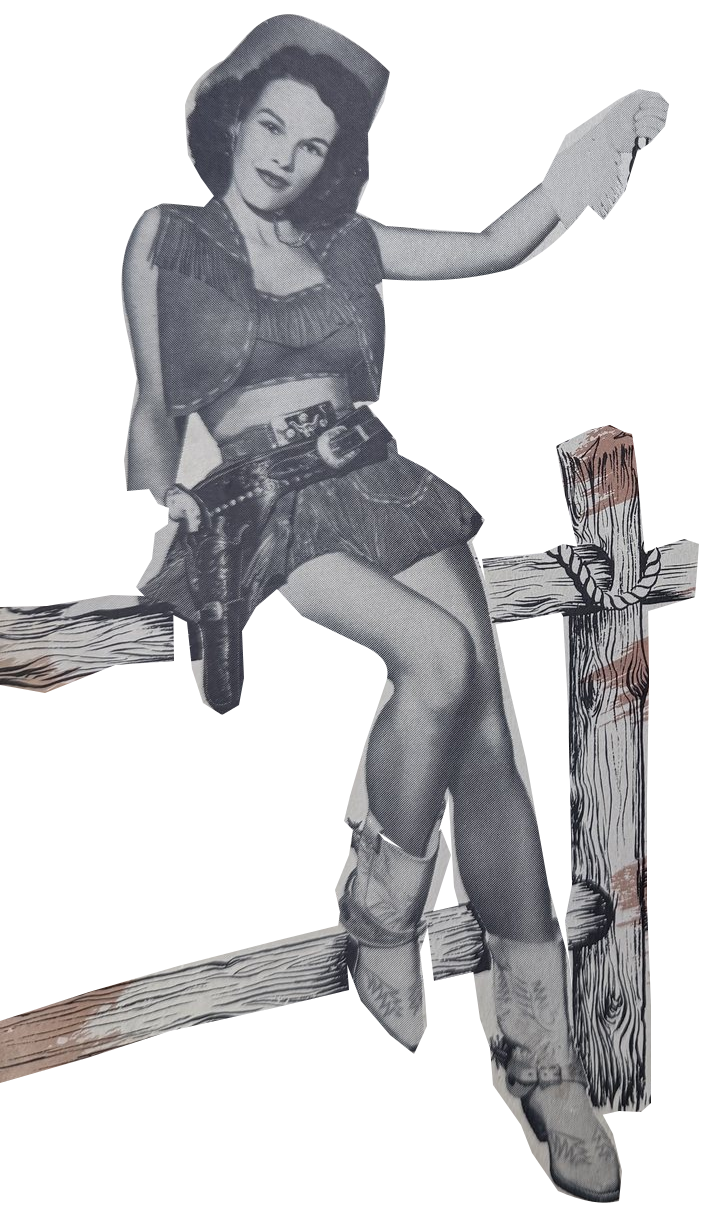
In March 1940, Russell Lee photographed a rodeo girl waiting for the parade that would open the San Angelo Fat Stock Show. She is dressed for a public event, but she is not yet moving down the route. That pause makes the photograph unusually good company for a history of Western clothes. The hat, blouse, trousers and belt are there to be seen; the catalogue does not name their maker, identify a shop, or tell us which part of the outfit she chose for riding and which for the parade. It gives us a performer, a place, a month and an occasion. That is plenty to begin with. (Source: LOC, San Angelo parade)
A parade turns clothing outward. People look at it from the curb, often before they know the wearer’s name. A rodeo asks dress to survive movement and also to announce a person across a ring. Neither setting has one uniform. The photograph is evidence of one woman at one event, not a rule for how rodeo women dressed. Yet it shows why Western tailoring became more than a private matter of fit. Clothes could help a person enter public view, whether she was awaiting a parade, riding before a grandstand, or stepping up to a microphone.
The show had already taught audiences how to look
Half a century earlier, Buffalo Bill’s Wild West supplied its audience with a programme. The 1893 order of events promised races and riding displays in which the company presented cowboys alongside Cossack, Mexican, Arab and Indian riders. It advertised Mexican lassoing and horsemanship, and another race with prairie, Spanish and Indian girls. Those are the show’s own categories. The programme tells us what the company chose to place before spectators and how it sorted people for a paying crowd; it is not a neutral roll call of the American West. (Source: 1893 Wild West programme)
On later pages, the programme described “The Vaquero of the Southwest” through a few conspicuous details of dress: a broad-brimmed hat, ornamented jacket, sash, buttoned trousers and spurs. Its imagined Eastern observer might mistake the rider for a circus performer. The line reveals the intended audience as much as it describes a garment. The show could praise horsemanship and still filter a living culture through an exoticising sales pitch. It is unsafe to lift that prose out of the programme and call it a universal account of Mexican riders’ everyday clothes. It is invaluable, though, as evidence of the spectacle’s visual vocabulary. (Source: 1893 Wild West programme)
A chromolithograph catalogued by the Library of Congress as an 1899 Buffalo Bill’s Wild West poster makes that vocabulary immediate. Round portraits of Cody and Nate Salsbury sit above mounted figures and lifted lariats; the bottom title advertises Mexican vaqueros and lariat experts. The print is a piece of promotion. Its mounted figures are not named portrait sitters, and it does not tell us who made a jacket or whether anyone rode in exactly that outfit. The 1899 catalogue date also keeps it separate from the 1893 programme. Put the two sources side by side and the larger change becomes visible: the show printed a set of types in prose and sold them again as an image a passerby could understand at a glance.
A Philadelphia tailor puts the arena in print
By August 1938, “Ben the Rodeo Tailor” could reach a customer through a small Billboard advertisement from Philadelphia. The shop offered made-to-order Western clothes for cowboys, cowgirls and children, a free catalogue, and its West Columbia Avenue address. The wording matters because it names both the shop’s intended audience and the way the offer travelled. One did not have to enter a Philadelphia storefront to encounter Ben’s idea of Western dress. The advertisement does not prove an order was placed, a particular costume was delivered, or that every customer rode in a rodeo. It establishes the offer the business printed. (Source: Billboard, 1938)
Bernard “Rodeo Ben” Lichtenstein’s later museum-described garments show what a named workshop could make visible on a person. The Country Music Hall of Fame attributes a checkered wool-gabardine suit with leaves, musical notes, contrasting piping, eyelet lacing and arrowhead-stitched smile pockets to him for radio performer Skeets Yaney. It attributes a cream bolero with embroidered, rhinestone-covered hawks to him for singer Hawkshaw Hawkins. In the latter, a stage name becomes a readable image across the shoulders. These are two particular museum presentations, not a standard Ben pattern. The museum captions do not give this project an original work order or the name of every worker who cut and stitched each piece. (Source: Rodeo Ben exhibition)
The Hall of Fame also attributes a two-tone outfit worn by Schuyler “Sky” Snow of Jerry & Sky to Rodeo Ben. On a different exhibition page, it identifies a Fay Ward shirt and pinstripe ensemble for the same performer. That is a useful warning against collapsing a performer’s wardrobe into one tailor’s life story. The museum is presenting distinct garments. Their shared wearer does not make them one commission, one date, or proof that the shops worked together. It does show that a duo’s public image could be made from more than one maker’s work.
A woman carried between two kinds of selling
The owner-held Rodeo Ben catalogue gives Berva Dawn Taylor a place in its visual cast. Printed pages 46–47 show her modelling two different shop outfits, numbered 263 and 264. The catalogue says she modelled Ben’s clothes on the rodeo circuit. Those are the shop’s printed pictures and claim; the catalogue’s edition and date are not yet secure, and its pages do not amount to a list of every event or garment she wore. (Source: owner-held Rodeo Ben catalogue, printed pp. 46–47 (private source card))
In a separately reproduced Blue Bell advertisement, the same woman appears under the printed name Berva Dawn Sorensen, called a rodeo performer. The image markets women’s Wrangler jeans with fit, leg-length and zipper choices. A later Texas Rodeo Cowboy Hall of Fame profile records her marriage to Dan Taylor in 1952, but that retrospective fact does not let us date either undated printed image precisely from the name alone. Nor does the Blue Bell crop show a Rodeo Ben credit. The catalogue outfits and the jeans advertisement are two different presentations of a woman whose rodeo standing could sell both custom clothing and mass-produced denim. They do not prove Ben designed the jeans in that ad.
This is a more interesting story than treating a “cowgirl” as a decorative counterpart to a cowboy. Berva Dawn’s name appears in two sales settings, each asking a different buyer to look at her. The custom shop’s catalogue shows elaborately selected outfits; the denim advertisement argues for fit and choice. The same public identity could carry both appeals, while the clothes, dates and makers still need to be described separately.
The route does not stop at the arena gate
Fay Ward’s New York shop advertised to customers in several worlds at once. A 1953 Down Beat advertisement addressed rodeo, radio, television, record and screen customers, and offered an illustrated catalogue. In 1960, the company advertised custom shirts, complete suits and parade outfits from West 48th Street. The pages tell us what the firm proposed to sell and to whom it spoke. They do not tell us the volume of production or provide a roster of every person it dressed. They do, however, refuse an easy border between rodeo and show business. A Western suit could be offered to a rider, a musician and a parade client through the same commercial vocabulary.
Return to the woman waiting in San Angelo. We still cannot name the maker of her blouse or say what she wore after the parade. We can now see more clearly what the photograph holds: one performer on the threshold of a public arena in a long history of people who dressed, photographed, advertised and interpreted Western riding. The record moves from programme to poster, from tailor’s ad to surviving suit, from catalogue portrait to denim pitch. Each medium gives the clothes a new audience. None makes the person in the frame any less real.
Sources & further reading
- Library of Congress, Russell Lee, *Rodeo girl performer waiting for the parade*
- Library of Congress, Russell Lee, *Cowboy at rodeo, Quemado, New Mexico*
- Library of Congress, Buffalo Bill’s Wild West company programme, Chicago, 1893
- Library of Congress, Mexican Vaqueros and Lariat Experts poster, 1899
- *Billboard*, 27 August 1938
- CMHOF, “Rodeo Ben: The Expression of Perfection”
- CMHOF, “Western Style Roundup”
- Blue Ridge Public Radio, 2015 reproduction of an undated Blue Bell advertisement naming Berva Dawn Sorensen
- Texas Rodeo Cowboy Hall of Fame, Berva Dawn Sorenson Taylor retrospective
- *Down Beat*, 18 November 1953
- *Country Music Who’s Who*, 1960