An illustrated history
Western wear.
Who made the cowboy visible
A history written in the clothes.
In March 1949, a LIFE advertisement put a cowboy on horseback, rope in hand, above a pitch for Wrangler jeans. The page named him Gerald Roberts and billed him as a champion. Beneath the picture, Blue Bell printed a second kind of credential: “Styled by Rodeo Ben.” A rodeo image, a commercial product, and a Philadelphia tailor’s reputation met on one sheet of paper. The ad tells us what Blue Bell wanted readers to believe; it does not tell us which parts of the jeans Ben designed, or whether Roberts was wearing that particular pair. That distinction is a good place to begin the history of Western wear.
The cowboy look had not travelled from a range directly to this magazine page. Its elements had been made and remade through work, migration, performance, retail, manufacturing, and a century of people imagining what the West ought to look like. A ranch hand’s chaps and a singer’s rhinestone suit may share leather, stitching, and a dramatic outline, but they were made for different bodies, different jobs, and different audiences. The advertisement sold the authority of one world to the customers of another.
To follow the clothes, ask who made each version, for whom, under what conditions, and where it travelled. A garment might answer an occupational need, pass through a tailor’s workroom, meet a performer’s idea of a stage identity, and reach the public in a catalogue, a film still, or a record sleeve. Its maker’s name may be printed on the label; the people who cut, stitched, embroidered, finished, photographed, and sold it may be harder to find. The history belongs to them too.
A West made through exchange
The clothes called Western did not descend from one timeless American uniform. Horse cultures in the Americas grew through encounters among Indigenous peoples and European, African, and other communities. The National Cowboy & Western Heritage Museum places New World horse culture in the world of New Spain and colonial Mexico. The Library of Congress has separately called attention to Spanish vaqueros and Black cowboys, figures often pushed to the edges of the popular white-cowboy story. These are not side notes to a settled origin; they change the frame of the story itself.
The vaquero tradition mattered to the equipment and language that later circulated through the ranching West. Yet it is too easy to turn that history into a single line of inheritance, as if one community passed an unchanged outfit to another. Clothing was adapted to local work, climate, materials, and custom. The same word or shape could mean something different from one region to the next. A broad cultural history can identify exchange; a claim that a particular stitch, motif, or garment came from one people needs a more specific source.
That distinction matters because the later commercial image often presented Western clothes as if they had always belonged to one kind of cowboy. The archive shows a wider field: Indigenous, Mexican, Black, immigrant, and women’s histories; workers and performers; ranch clothing and theatrical costume; local shops and national brands. The familiar silhouette is real, but it is not the whole cast.
Nor is the familiar silhouette an origin story. A brim, a boot, a neckerchief, a pair of chaps: each has a history that deserves more than a line pointing vaguely west. Some belonged to particular kinds of work; others became legible to an audience because a photograph, a parade, or a film repeated them. To understand how those things came to look like one outfit, we have to keep the working object and the public image in view at the same time.
Clothes that had to work
Workwear begins with a task. Chaps protect the legs against brush and friction. A neckerchief can shield the face from dust. Gloves, spurs, boots, and a broad-brimmed hat each answer practical demands of riding and outdoor work. The details vary by place and occupation, and the objects are not interchangeable simply because a later picture groups them under “cowboy gear.”
There was never one standard working outfit for every ranch hand. In the Library of Congress’s study of Northern Nevada buckaroo culture, some clothing choices answer practical needs while others carry symbolic weight; conspicuously fancy dress could even mark a person as an outsider in that particular community. That account is a valuable regional case, not a rule for all ranching life. It helps keep the history grounded: a garment can protect, identify, signal skill, mark belonging, or do several of those things at once.
Working clothes also enter the historical record unevenly. The spectacular garment is more likely to be saved than the shirt worn thin at the cuff. A famous owner gives an object a route into a museum or auction catalogue; an ordinary worker’s clothes may leave no named record. Photographs help, but a photograph can conceal as much as it reveals: it may identify a wearer while leaving the maker, setting, date, and purpose uncertain. That imbalance is one reason labels, advertisements, catalogues, and workshop records matter so much.
The imbalance also changes the questions a history can answer. A museum suit may tell us exactly how one performer wanted to be seen; it cannot stand in for the clothes of everyone who worked cattle. A ranch photograph may show bodies, weather, and wear, yet leave the clothes’ makers unknown. Put those records together and a change comes into focus: Western dress became a public image without ceasing to be somebody’s working equipment. The two histories meet, but neither can be used as a substitute for the other.
When the West acquired a programme
In 1893, Buffalo Bill’s Wild West gave its audience a printed order of events. A horse race would set a cowboy beside a Cossack, a Mexican, an Arab and an Indian rider. Mexican performers were promised in a lassoing and horsemanship display; another race advertised prairie, Spanish and Indian girls. The list is a record of how the company arranged a spectacle, not a census of the West. Its named groups show the range of riding traditions the show put before spectators, while its divisions made those people legible as contrasting types.
Farther into the same programme, a section headed “The Vaquero of the Southwest” turns clothing into part of that contrast. It describes a broad-brimmed sombrero, an ornamented jacket, a coloured sash, buttoned trousers and large spurs. Then it imagines an Eastern onlooker mistaking the dressed rider for a circus performer. That sentence tells us more about the programme’s intended reader than it does about the daily wardrobe of Mexican horsemen. The company could acknowledge vaquero skill and dress while writing through a racial hierarchy and a showman’s appetite for the picturesque. The passage is evidence of its sales pitch, not an authority for how every vaquero looked or lived.
A colour poster catalogued by the Library of Congress as an 1899 print shows how far that public image could travel. Cody and his manager Nate Salsbury appear in round portraits above mounted riders who raise lariats; the lower border advertises Mexican vaqueros as the attraction. Broad hats, coloured jackets, belts and the movement of horses become a legible spectacle even at a glance. The poster has no garment labels and names no individual rider below the portraits. Its riders are lithographed figures designed to sell a performance, not an item-by-item record of what named people wore in 1899. Six years separate the catalogue date of this poster from the 1893 programme; the two belong together as evidence of the show’s visual sales language, not as one event or one set of costumes.
The programme makes the change in scale plain. A person might dress to work with a horse, but the printed show asked clothing to identify a performer to a crowd before the horse moved. The Wild West’s writers selected a few visible features and offered them as instantly readable signs of a type. Clothes entered a commercial story about authenticity at the same moment that real people wore them in a staged arena. Those are connected histories, and they are not the same account.
Surviving objects keep that distinction from becoming merely a matter of rhetoric. The Buffalo Bill Museum holds clothing attributed to performers including Cody, Annie Oakley and others, alongside a broader collection of working and designer Western apparel. Its inventory shows that Wild West dress can be studied as material objects, not only as a printed promise. But a company programme cannot identify the maker of every surviving garment, and a museum object does not verify every claim the show made about the people who wore it. Each needs its own record.
The cowboy becomes a public figure
The public cowboy was built in stories and spectacles as well as on the range. Rodeos, parades, radio, and screen carried images of the West to audiences far from ranch country. A costume had to read quickly. It needed a recognizable outline from the grandstand or the back row, and it had to survive the movement of a horse, a parade route, or a film scene. The Library of Congress’s account of the American West sets popular myth beside labor history; the museum’s tailor histories show how makers answered those performance settings with clothes made to be seen.
That visibility changed what clothes could do. A working garment might be recognized by its cut or material; a performance outfit could turn the wearer into a character before he spoke. The show cowboy did not merely reflect a settled tradition. He helped make one. Cinema and radio carried those versions into homes, while rodeos and parades put them in motion before a crowd. Those images shaped expectations about the clothes even when the garments were designed for performance rather than ranch work.
Singing cowboys made that overlap especially visible. Their clothes had to evoke the range and register on a screen, a stage, a publicity photograph, or a record cover. Yet performers were not blank mannequins for a tailor’s taste. A 1941 Radio Varieties profile described Gene Autry’s cowboy clothes as being of his own design and noted coordinated suits, shirts, hats, and boots in conspicuous colours. The item is publicity and does not identify a maker for those clothes. It does show that performer self-fashioning belonged in the public story.
A band made another demand on the tailor. One jacket could distinguish a singer; a matched group needed to read as an act before the first note. The Maddox family had come from Boaz, Alabama, to California in 1933 and picked fruit before the siblings formed a band in 1937, according to the museum's account. The later stage photograph belongs to that longer journey, though it cannot date an individual commission. The museum presents representative pieces from five matching Nathan Turk sets. Satin and wool gabardine carry coloured snaps, piping, fringe, and chain-stitched vines and flowers. Rose Maddox explained that matching shirts and trousers let the band take off its jackets in summer and keep a complete appearance. The clothes had to be worn in summer as well as hold a group together in a picture.
That picture kept changing with the medium. The Library of Congress identifies the yellow Nathan Turk suit on Buck Owens and matching blue Turk suits on the Buckaroos in the photograph used for their 1966 Carnegie Hall Concert album. A 1940s stage group and a 1960s record sleeve are not the same setting, yet both show why performers asked clothes to do more than cover them. The garment had to work at close range, across a hall, and as a small printed image. The Library’s essay identifies the suits in that particular photograph; it is not a catalogue of every costume the band wore.
The tailor’s shop enters the picture
By the 1930s, custom Western tailors were working across rodeo, parades, film, radio, and the growing country-music business. Their shops brought tailoring to an image already in motion. They could fit a performer, echo a stage name in embroidery, make a band look like a band, or supply a customer who wanted something more distinctive than ready-made workwear.
Bernard “Rodeo Ben” Lichtenstein’s Philadelphia business shows how a custom shop could reach beyond its storefront. His advertisements and catalogues addressed cowboys, cowgirls, children, rodeo performers, entertainers, and musical groups. A 1938 Billboard advertisement offered a new free catalogue; later notices promoted made-to-order suits and described shirts, trousers, jackets, boots, hats, and capes. The language grew more theatrical as the shop sold itself to a public that included riders and performers. These advertisements establish what the business offered and whom it hoped to reach; their claims about being “original” or “finest” remain the shop’s own sales language.
The surviving garments make that offer tangible. The Autry’s record for a 1930s Rodeo Ben shirt worn by Gene Autry describes gabardine, brown piping, crescent-shaped arrow pockets, horse-head appliqué, hand embroidery, sequins, metallic beads, and mother-of-pearl snaps. A separate outfit for Schuyler “Sky” Snow combines a contoured yoke and whipcord piping with “V” pockets and chain-stitch flowers. A bolero for Hawkshaw Hawkins turns his stage name into embroidered and rhinestone-encrusted hawks. These objects show the range of the shop’s visual vocabulary. They do not prove Rodeo Ben originated the features they use.
In Los Angeles, Nathan Turk and Bessie Turk built another kind of workshop story. Nathan, born Nathan Teig, trained as a tailor in Warsaw before immigrating to the United States and opening an alterations business in the early 1920s, according to the Country Music Hall of Fame. The family shop later served performers including Gene Autry and Roy Rogers. The Maddox Brothers & Rose wore coordinated Turk costumes in wool gabardine and satin, with coloured snaps, piping, fringe, and embroidered motifs. The clothes made a musical group appear as a visual unit.
Bessie Turk’s finishing work gives the garments a more complete authorship. The museum attributes hand-sewn arrowheads that reinforced pockets and seams to her. On the finished clothing, reinforcement and decoration meet in the same small detail. That account is specific to the Turk objects; it is not evidence that Bessie invented the arrowhead or that she finished every Turk garment.
The work behind the name
The label names the house; the seam can lead us further inside it. In Bessie’s arrowheads, a useful piece of finishing became part of the costume’s visual language. No catalogue slogan is needed to make the point. The detail is small enough to miss in a photograph of the whole band, yet it had to be made before the band could take that photograph.
It is tempting to read a finished suit as one person’s idea made material. Bessie’s arrowhead makes that temptation harder to sustain. A little shape at a pocket edge can be practical reinforcement and an ornament visible to the customer. It also records a worker whose name may not appear beside Nathan’s on the label. The later Turk outfit photographed for the Buckaroos takes this small-shop question onto a much larger stage: who planned the look, who cut it, who finished it, and which name survived in the record? We can name the shop and, in the documented finishing example, Bessie’s hand. The evidence does not answer every part of the production chain.
Nudie and Bobbie Cohn made their shop a public-facing institution of its own. They began by producing rhinestone costumes for burlesque performers and showgirls in Manhattan in 1934, then moved to Los Angeles and opened Nudie’s Rodeo Tailors in North Hollywood in 1950. The shop’s records include customer files, correspondence, photographs, boot records, and publications—a rare paper trail behind the famous label. The museum’s account describes a 1951 suit for Lefty Frizzell as a turning point in the shop’s use of rhinestones, and later pictorial suits carried images tied to a song, a name, or a performer’s identity.
Migration belongs in this story as lived history, not as a decorative origin line. The Country Music Hall of Fame says Bernard “Rodeo Ben” Lichtenstein was born into a Jewish family in Poland and reached Philadelphia with his family at fourteen. It places his Western tailoring storefront there in 1930. The museum traces Nathan Turk from a village near Minsk to a tailoring apprenticeship in Warsaw and, later, a Los Angeles shop. Nudie Cohn was born into a Jewish family in Kyiv and sent to the United States as a child; his and Bobbie’s Manhattan costume business preceded the North Hollywood shop. These are institutional biographical accounts, not passenger lists or a complete record of each family’s journey.
The three businesses took different routes through the same expanding public West. Ben used a Philadelphia workroom, catalogues and rodeo visits to reach distant customers; Turk’s Los Angeles shop served film and music performers; the Cohns carried experience dressing New York entertainers into Western stage wear. The evidence does not make those routes interchangeable, and it does not let us assign a flower, yoke or rhinestone pattern to a maker’s birthplace. What it makes visible is harder to reduce to one heroic inventor: trained immigrant tailors, family members and other specialists answered American performers, audiences and markets with clothes they could cut, fit, sell and make legible from a distance.
That fact changes how the show clothes look. Their subjects might have been a rider, a sheriff, a horse, or a song heard on the radio. Their production belonged to businesses with rent to pay, customers to fit, orders to finish, and workers whose names reached the archive unevenly. There is no reason to make the result less dazzling. The better history lets the dazzle and the work occupy the same frame.
But “Nudie suit” can make a workshop sound like one person’s hand. The archive finding aid names Viola Grae and Rose Clements as master embroiderers, and also identifies Manuel Cuevas and Jaime Castaneda among the shop’s staff. The Hall of Fame credits Grae with the embroidered scene on Hank Thompson’s “Humpty Dumpty Heart” boots. Bobbie’s business work and continued stewardship after Nudie’s death in 1984 belong in the same history. A label could give the shop its public identity while many kinds of labour made each garment possible. The surviving records let us name some of those workers; they do not let us assign every stitch or design choice across the whole shop.
Look at Thompson’s boots as more than a footnote to Nudie’s fame. The pair turns the title of his song into a scene: hearts with faces, a wall, and broken hearts worked across curved leather. The museum identifies them as Thompson’s Nudie boots and credits Grae with the embroidered scene. It does not date the pair or document a particular performance in them. That is a specific credit for work on one object, not a formula to impose on every pair that left North Hollywood.
Grae’s name did not live only in another shop’s archive. Auction photographs show garments bearing a sewn “Viola Grae / California” label, and a separately presented Walking Box Brand ensemble carries an “Embroidered by Viola Grae” credit. Those pictures document visible words on particular objects; the sellers’ dates and ownership stories require further proof. Still, a maker’s own label and an embroidery credit beside another brand complicate the usual map of rival tailoring houses. A specialist’s work could cross the border drawn by a shop sign.
That shop ecology was broader than the best-known names. Marge Riley’s Los Angeles business and Palm Springs branch served performers and customers through the 1930s and postwar years. Fay Ward’s New York business advertised illustrated catalogues and offered clothing “from a shirt to a complete suit,” including parade outfits. His 1953 Down Beat advertisement addressed rodeo artists and people in radio, television, records, and screen. Such evidence makes the customer network visible: a Western garment could be ordered, fitted, advertised, performed, and photographed across very different settings.
The geography matters. If a history goes from Los Angeles to Los Angeles, it has mistaken the surviving celebrity image for the entire trade. Rodeo Ben’s catalogue route began from Philadelphia. Ward advertised from New York. Riley’s name remained visible in Palm Springs directories. These addresses do not measure the size of anyone’s business, but they show how the vocabulary of Western dress could be offered from cities and shops beyond the places where a film or record photograph was made.
A stage look made at home
A famous tailor's order book was not the only way into a Western stage look. The Hall of Fame notes that custom costumes were beyond some performers' means. In early appearances, Patsy Cline wore a cowgirl outfit designed and sewn by her mother, Hilda Hensley: fringe, piping, felt broncos and riders, and rhinestones translated an admired stage vocabulary through her own hands. Birdie Lee Tuberville Brown designed and made a shirt and skirt for her daughter Maxine Brown, who wore them while performing with Jim Ed on Little Rock radio. These are two documented outfits, not a claim about everything either singer later wore.
The garments put family work next to shop work without pretending the settings were identical. One route ran through a staffed shop and an order book; another through mothers sewing for performers in their own families. The museum identifies the makers of these particular pieces, but it gives neither household a complete budget nor a sewing diary. The point is concrete: Western music's public image could be made at home as well as in a celebrated tailor's workroom.
The catalogue and the counter
Mail-order catalogues changed the scale of the story. A customer did not have to live near a tailor’s shop to see its designs or request a garment. Rodeo Ben’s advertisements repeatedly announced new catalogues and described clothing for varied customers. The catalogue was more than a price list: it placed garments, options, names, and the shop’s own account of Western style before readers who might never enter the Philadelphia storefront. The surviving catalogue evidence is incomplete, and two descriptions of different page counts have not yet been reconciled. The sequence of advertisements, however, establishes that catalogue production was a recurring part of the business.
Custom work and commercial production grew alongside one another. The Hall of Fame describes postwar demand that independent tailors could only partly meet, while commercial makers put embellished Western shirts before a broader market. Rockmount dates its business to 1946 and describes its own snap-front design and distinctive pocket and yoke details. These are first-party company claims and belong in that context. A claim that one company invented a feature for the whole trade needs independent dated evidence.
The retail counter gives us a more exact view of that market than a general claim about fashion’s spread. A 1954 Harman’s advertisement in Bovina, Texas, named Rockmount Western shirts, printed “Pearl Snaps” and “6 Snaps on Sleeve,” and offered a price range of $4.98 to $6.90. The ad does not prove what was sold or where the shirts were made. It does show what one merchant thought would attract customers on that July page: fit, fastenings, and a price someone could compare with the rest of the store.
The commercial field was not a simple replacement of custom tailoring by factories. A shop could sell both its own name and particular looks; a retailer could shape which goods customers saw; a catalogue could circulate designs far beyond a maker’s town. In 1949, a full-page Blue Bell Wrangler advertisement in Life called the jeans “authentic Western” and printed the credit “Styled by Rodeo Ben, tailor to top rodeo stars!” A 1952 local newspaper reported that Blue Bell gave a Wrangler jeans-and-shirt set to a young cowgirl and stated that Rodeo Ben designed the garments. Together these sources establish that a public association between Rodeo Ben and Wrangler appeared in period advertising and reporting. They do not establish a contract, the scope of his design role, or authorship of every Wrangler garment.
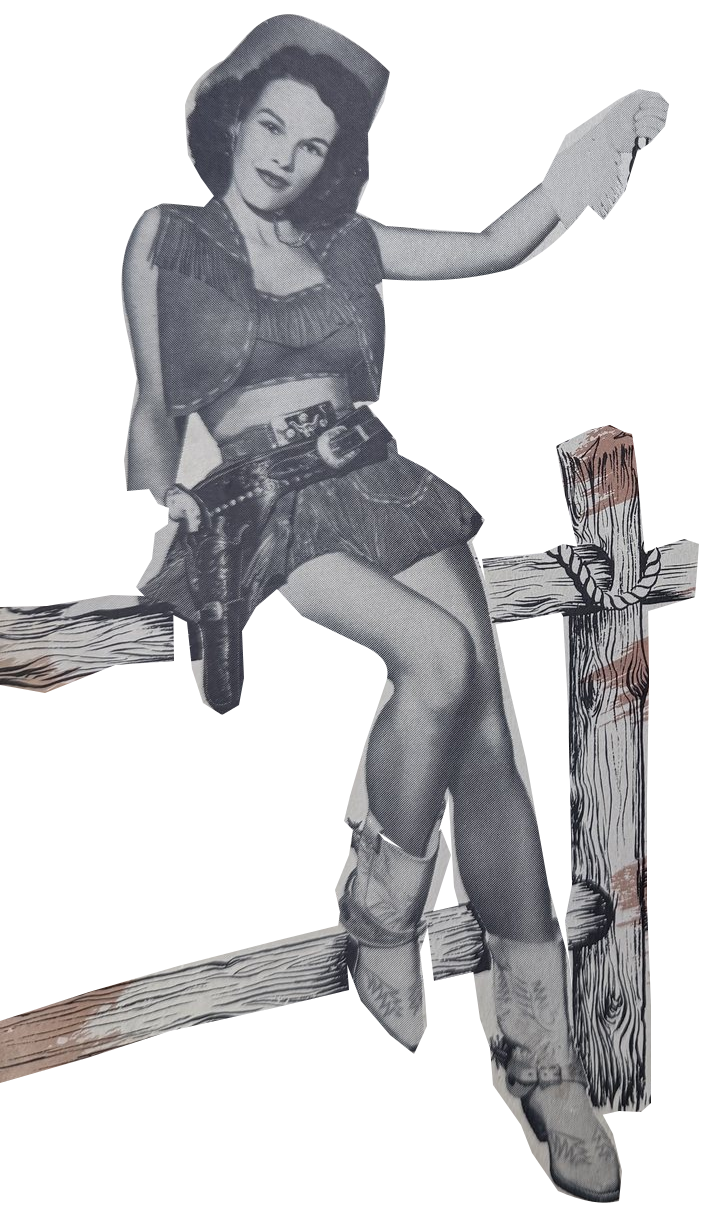
A different Wrangler advertisement puts Berva Dawn Sorensen at its centre. Blue Bell calls her a rodeo performer and shows her with horse tack, a checked Western shirt, jeans and light boots. The copy addresses women as buyers, promising a snug cut, choices of leg length and zipper placement, and printing a price. In Rodeo Ben's undated catalogue, she appears in two very different bespoke outfits: a star-trimmed parade suit and a striped coat. The catalogue calls her Berva Dawn Taylor; a later Hall of Fame profile records her 1952 marriage to Dan Taylor. The two printed names and sets of clothes make her visible in two kinds of Western selling: a custom shop's rodeo-circuit promotion and a manufacturer's denim appeal. We cannot sequence the undated catalogue and advertisement from the names alone. The Wrangler crop has no original issue date and no Ben credit. The pictures do not establish that his shop made or designed the jeans she wears.
Retail advertisements also show how many labels could meet on one local page. In 1949, Cobb’s in Muleshoe invited readers to see shirts, frontier pants, and jackets “by H-Bar-C” in a Fat Stock Show advertisement. In 1953, Prager’s Men’s Store in Big Spring listed H-Bar-C, Tem-Tex, and California Ranchwear shirts, as well as H-Bar-C suits and pants. The following year, an Addington’s panel in Pampa said its Western shirts were made by Rockmount, Tem-Tex, and Levi-Strauss. These are retailer statements about the goods being offered or described on those pages. They place brands in local commerce; they do not by themselves prove ownership, factory relationships, stock, sales, or a supply chain.
Broadway Sporting Goods in Oakland was offering Western wear to dancers before its September 1953 shirt advertisement. In February 1953, the shop advertised Western wear to square and folk dancers and listed H-Bar-C, Levi Strauss, California Ranchwear and Western Apparel, with boots and hats below. The list does not assign a particular garment to each name. By September, the same shop specifically advertised Tem-Tex and California Ranchwear shirts. These were store offers in a dance magazine, not orders found in a tailor’s book. They show retailers asking customers to imagine Western dress on a social floor as well as in an arena.
The dance trade also offered more than shirts. In November 1964, J. P. Western Wear in Pine Brook, New Jersey, listed “H-C (California Ranchwear)” among square-dance dresses; a separate column addressed men’s pants, shirts, ties and boots. The parenthesis is the shop’s printed wording, not proof of a corporate name change or of who made a particular dress. But the page catches Western style being sold across garment categories, to people whose stage was a club floor. The history of the look grows smaller if those buyers disappear behind the image of the solo singing cowboy.
The sequence does not run simply from custom shop to factory to consumer. A national magazine might sell denim with a tailor’s name. A Texas newspaper might describe a Wrangler outfit given to a young rodeo cowgirl and attribute its design to that same tailor. A local shop might place several branded shirts side by side in an advertisement. A square-dance reader in California might see Western shirts promoted for a social floor rather than an arena. Those are different paths through which an image of the West became purchasable. None of these printed traces is a receipt proving a sale; together, they show the range of occasions for which the clothes were offered.
The scale of the audience changed what an image could accomplish. A bespoke suit attached a design to one performer and, often, one performance identity. A catalogue could make that design visible to customers outside the shop’s city; a manufacturer could attach a tailor’s authority to ready-made jeans; a retailer could place several labels before the same local reader. Those channels did not erase the tailor. They multiplied the ways a Western look could be offered, copied, compared, and remembered. The advertisements tell us about those offers, not how many people accepted them.
What a label can—and cannot—tell us
A label is a beginning, not a biography. It may name a maker, shop, brand, city, or distributor; it may also change across garments or over time. An auction photograph can preserve wording no longer visible elsewhere, but a seller’s description does not by itself establish a garment’s date, wearer, ownership, or maker. The archive therefore keeps the wording of each label tied to the individual object on which it appears.
That discipline matters especially in a field where a famous wearer can overwhelm the evidence. A stage photograph may show the suit clearly and say nothing about who cut or embroidered it. A later recollection may preserve an important workshop relationship without supplying dates or payroll records. A museum attribution can securely identify work on one object without becoming a blanket credit for every garment bearing the shop’s label. The task is to make the story vivid while keeping each name attached to what the record can actually support.
The history keeps moving
Western wear did not stop changing when the classic rhinestone suit reached a museum case. Its images continue through contemporary makers, vintage shops, auctions, stage revivals, and fashion collections. The Country Music Hall of Fame’s account of the “rhinestone resurrection” points to makers carrying custom embellishment into new settings. That is evidence of continuing practice, not proof that today’s clothes simply repeat an unchanged past.
Collecting changes the evidence too. A suit worn by a recognised performer is more likely to be photographed, sold with a story, and kept than the shirt an unnamed worker wore to pieces. A label can survive while the order book disappears. A wonderful auction photograph can show us a sleeve and still leave its wearer or date unresolved. The temptation is to let beauty make the attribution. The better pleasure is looking closely enough to notice both what the garment gives us and what it withholds. That is why this site follows the object, the original image, and the paper record together, and why it leaves some names and dates open.
Return to the 1949 LIFE page. Roberts is moving on horseback. The denim is offered for sale. Rodeo Ben’s name lends a tailor’s authority to a manufacturer’s claim. One printed page brings the rider, the maker’s reputation, and the commercial audience together; it does not collapse them into one life or one kind of work. Look past it and the scene grows crowded. Bessie Turk’s reinforcement sits at a pocket edge. Grae turns a song title into a stitched joke on a boot. Fay Ward offers clothes through a catalogue. The Buckaroos stand together in suits made to become a record image. A Texas merchant prints the price of a snap shirt.
Those traces do not add up to one inventor or one authentic cowboy. They show people making, wearing, selling, and keeping different versions of the West, sometimes on the same piece of cloth. The famous outfit begins to look less like a costume that appeared fully formed and more like a meeting place: work and play, migration and business, an individual hand and a public image. Its history is richest when the names on the label do not stop us looking for the people beyond it.
Stay with the details.
Sources & further reading
- Augusta Auctions, October 2008 past-sale listings, lots 694, 696, 697 and 700
- Augusta Auctions, Rex Bell’s Walking Box Brand ensemble
- Online Archive of California, *Nudie’s Rodeo Tailors Archives, 1950–1994*
- Autry Collections, Rodeo Ben shirt 91.221.560
- Buffalo Bill Center of the West, Buffalo Bill Museum collection overview
- Blue Ridge Public Radio, 2015 reproduction of an undated Blue Bell advertisement naming Berva Dawn Sorensen
- CMHOF, “Western Style Roundup”
- CMHOF, “Manuel: The Rhinestone Rembrandt”
- CMHOF, “Nudie Cohn: The Original Rhinestone Cowboy”
- Country Music Hall of Fame and Museum, “Coming to America”
- CMHOF, “Nathan Turk: Old World Meets New West”
- Country Music Hall of Fame, *Suiting the Sound* overview
- CMHOF, “Rodeo Ben: The Expression of Perfection”
- Country Music Hall of Fame and Museum, Rhinestone Resurrection
- *Country Music Who’s Who*, 1960
- Addington’s, “Western Shirts,” Pampa Daily News, 30 November 1954, p. 9
- Harman’s, “Dollar Day,” State Line Tribune, 29 July 1954, Section II p. 4
- *Down Beat*, 18 November 1953
- *The Floyd County Hesperian*, 31 January 1952, p. 1, “Floydada Cowgirl Sweetheart Given Wranglers Jeans”
- Google Books, *Ben the Rodeo Tailor: Clothes Made to Order*
- J. P. Western Wear, Square Dance Dresses, Grand Square, November 1964, p. 7
- Prager’s Men’s Store, “Howdy Visitors!”, Big Spring (Texas) Herald, 5 August 1953
- Cobb’s, “Western Clothes,” The Muleshoe Journal (17 March 1949)
- Los Angeles Times, Bobbie Nudie obituary (2006)
- Broadway Sporting Goods Store, Western Wear for Square and Folk Dancers, Let’s Dance!, February 1953, p. 15
- Broadway Sporting Goods Store, Western Wear for Square Dancers, Let’s Dance!, September 1953
- *LIFE*, 28 March 1949, vol. 26 no. 13, p. 138: Blue Bell Wrangler advertisement
- Library of Congress, Buffalo Bill’s Wild West company programme, Chicago, 1893
- Library of Congress, Mexican Vaqueros and Lariat Experts poster, 1899
- Library of Congress, “Clothing” in *Buckaroos in Paradise*
- Library of Congress, Russell Lee, *Cowboy at rodeo, Quemado, New Mexico*
- Library of Congress, *A cowboy*
- Library of Congress, “The American West, 1865–1900”
- National Cowboy & Western Heritage Museum, *Caballeros y Vaqueros*
- Library of Congress, “Carnegie Hall Concert with Buck Owens and His Buckaroos” essay
- Palm Springs city directory, 1964
- Palm Springs telephone directory, 1966
- Rockmount Ranch Wear, company history
- *Radio Varieties*, February 1941
- Texas Rodeo Cowboy Hall of Fame, Berva Dawn Sorenson Taylor retrospective
- *Billboard*, 27 August 1938
- *Billboard*, 8 April 1939
- *Billboard*, 13 April 1940
- *Billboard*, 31 July 1943
- *Billboard*, 27 May 1944
- *Billboard*, 2 December 1944
- *Billboard*, 31 March 1945
- *Billboard*, 25 August 1951
- Western Wear History Collection, Sam A. Formann Co. shirt photographs, submitted 29 September 2026